Who repairs Antminers in the UAE
If you own an Antminer in the UAE, there are three routes when it stops hashing. Independent repair shops in Dubai and across the region run benches with test fixtures and soldering stations for chip-level work. Bitmain runs an online support centre where owners open service tickets and find troubleshooting guides by model. And your hosting site has technicians who handle first-line checks and part swaps at the rack. At Segments you get the first and third route in one place: our repair service swaps fans, power supplies and control boards at our sites and sends hashboards to our lab in the UAE for chip-level work. It is open to any miner owner, not only hosting clients.
For a hosted miner you rarely need to pick a repairer yourself. The host sees the fault first, does what can be done on site, and coordinates bench work when it is needed. Your part is knowing enough to understand what you are told and to ask the right questions.
The four parts that fail most
An Antminer is a simple machine in layout: hashboards that do the work, a control board that runs them, fans or a coolant loop that carries heat away, and a power supply. Almost every fault traces back to one of these.
- Hashboards. A board drops off, reports fewer chips than it should, or runs hotter than the others. Common causes are a failed chip, a damaged temperature sensor, a loose or burnt connector, or dust and heat over time. The fix is often chip replacement on a bench.
- Fans. On air-cooled models, worn bearings or a fan reporting zero speed will make the miner protect itself and stop hashing. Hydro models have no fans on the unit; their equivalent is coolant flow and fittings, handled through the site's cooling loop.
- Power supply (PSU). Symptoms include no power at all, restarts when load rises, or boards that fail to start together. PSUs are usually swapped as a whole unit rather than repaired at the rack.
- Control board. The lights may be on but the dashboard is unreachable, the network drops, or the firmware is corrupted. Many cases are solved with a reflash; some need component repair.
For a longer list of symptoms and causes, see our guide to common Antminer faults.
 Illustration
Reading the error signs on the dashboard
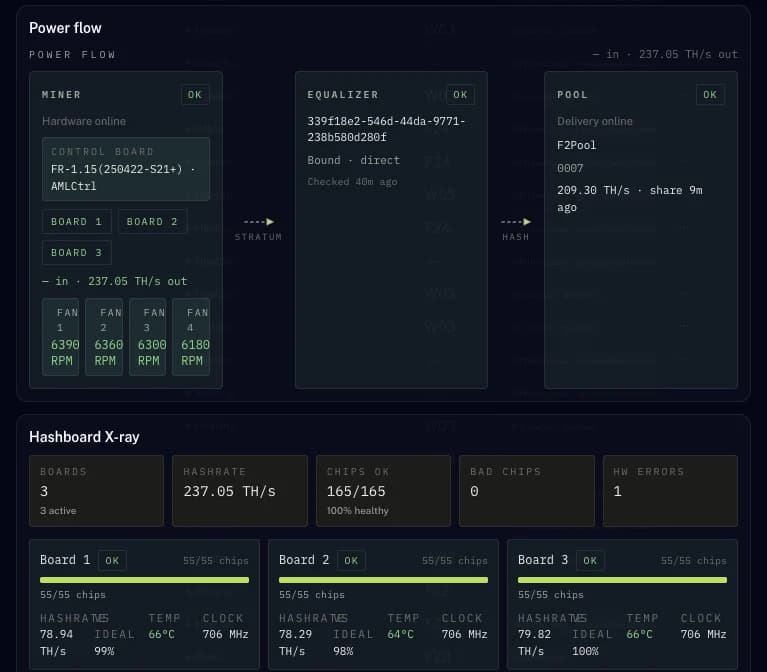
The Antminer web interface shows hashrate per board, chip count, board temperatures and fan speeds, plus a kernel log with the miner's own messages. Often the first sign appears elsewhere: a worker going offline or reporting low hashrate on your pool dashboard. If pools are new to you, read how mining pools work.
| What you see | Likely part | First check |
|---|---|---|
| One board shows no hashrate or missing chips | Hashboard or its data cable | Reseat the cable, read the kernel log |
| Fan speed at zero, or the miner stops with a fan message | Fan | Replace the fan |
| Miner restarts or drops boards as load rises | PSU or incoming power | Check input power, then swap the PSU |
| Lights on but dashboard unreachable | Control board or network | Check cable and IP address, then reflash firmware |
| Board temperature high or missing | Sensor or cooling | Clean, check airflow or coolant flow |
| Hashrate low across all boards | Heat, dust or firmware settings | Check intake temperature and the power profile |
One fault can look like another. A weak PSU can make a healthy hashboard drop off, so a technician usually rules out power and cables before condemning a board.
What is fixed on site and what is sent in
The dividing line is simple: anything that is a whole part or a setting can be handled at the rack; anything that needs a soldering iron goes to a bench.
Usually handled on site
- Fan replacement on air-cooled units
- PSU swap
- Reseating or replacing data and power cables
- Cleaning dust from boards and heatsinks
- Firmware reflash and network or pool settings
Usually sent to a repair bench
- Replacing failed chips on a hashboard
- Boards with several failed chips or damaged sensors
- Burnt connectors or traces
- Component repair on the control board
- Units with liquid or physical damage
Before anyone opens the case, check whether the manufacturer's service terms still apply to your unit, because third-party work can affect them. If you bought second-hand, our guide to buying a used ASIC miner covers what to check on arrival.
How repairs work at Segments
Segments hosts miners in the UAE in centres identified by code, including F20 and F54. Our operations team watches each miner's hashrate, temperatures and power draw, so most faults are spotted from the console before an owner notices them on the pool.
The usual sequence runs from least to most invasive: remote checks first, such as a restart, pool settings or a firmware check; then a technician at the rack who reseats cables, cleans the unit or swaps a fan or PSU; and, if a board needs chip-level work, it goes to our repair lab in the UAE. You get the diagnosis and a written quote before any work starts, and a photo and test report come back with the repaired unit. Ask us which parts are kept on hand at the centre where your miner sits. While a hosted miner is in repair, it is not billed for hosting, and a spare unit is available on request.
Repair time counts against availability, which is why uptime is a target rather than a promise. Our article on how mining uptime is measured explains how downtime for repairs is counted.
Air and hydro models are serviced differently. An air-cooled unit like the Antminer S21 has fans and a PSU that can be swapped at the rack; hydro units trade the fans for a coolant loop that the site maintains.
Antminer S21 (200T)
200 TH · 17.8 J/TH
Today's price
$1,740
See this miner
Questions to ask before you hand over a miner
- Who checks a miner when it goes offline, and how will I hear about it?
- Which repairs are done at the rack, and which go to a bench?
- Will I be told the fault and the repair scope before work starts?
- How are parts and bench work billed under my plan?
- Where is my miner while it is away for repair, and how is it tracked?
For how repair and parts costs appear on an invoice, see your mining hosting bill explained.
Questions
- Can I repair my own Antminer in the UAE?
- You can handle simple jobs yourself: cleaning, replacing a fan, swapping a PSU or reflashing firmware. Chip-level hashboard work needs a bench with test fixtures and experience, so most owners leave that to a repair shop or the manufacturer's service channel. If your miner is hosted, let the host handle it so the work is logged and the miner goes back into the right rack. Segments' repair service takes miners from any owner, hosted with us or not.
- My miner shows zero hashrate. What should I check first?
- Look at whether it is one board or all of them. If one board is missing, the cable or the board itself is the likely cause. If all boards are down, check power and the PSU first, then the control board and network. The kernel log on the miner's dashboard usually points in the right direction. If the miner is hosted, the operations team will usually have seen the drop already.
- How long does a hashboard repair take?
- It depends on the fault, the parts needed and the repair bench's queue, so ask for an estimate once the board has been diagnosed. Swaps at the rack, such as a fan or PSU, are generally quicker than chip-level work.
- Are repairs included in hosting?
- At Segments it depends on the plan. On Hosting, a new miner bought from Segments has free repairs for a first period and keeps the maker's warranty; after that, repairs are quoted at cost before any work. Full-care hosting has no repair charges for its whole term. On either plan a hosted miner is not billed for hosting while it is in repair, and the hosting page shows the current terms. With any other host, check the agreement before you need it.
Sources
- Bitmain Support Center · Bitmain, 2025-01-01