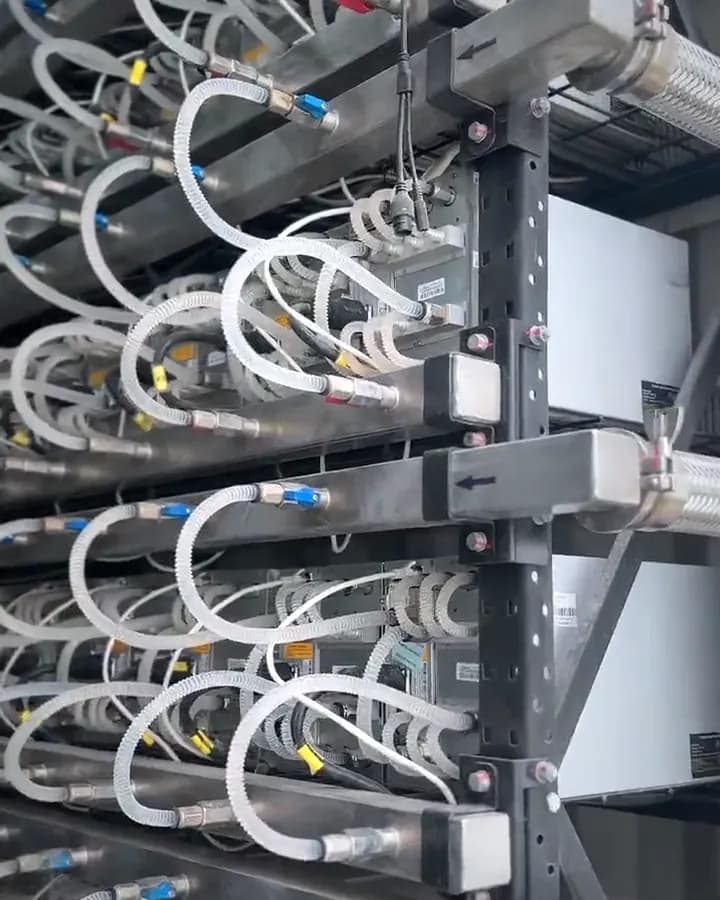
The two miners at a glance
Both machines come from MicroBT's WhatsMiner line, and the main difference between them is how they get rid of heat. That one difference shapes where each can be hosted, how much power each needs, and what the site has to provide. Each model ships in several hashrate versions, so the figures below are ranges from MicroBT's documentation and published spec listings (MicroBT). Check the label on your exact unit, because figures change between batches and firmware versions.
| Item | WhatsMiner M61S+ | WhatsMiner M63S+ |
|---|---|---|
| Cooling | Air, with built-in fans | Hydro, with a liquid cooling loop |
| Where the heat goes | Into the hall air | Into the coolant, then out through dry coolers or towers |
| Hashrate | About 216–236 TH/s, by version | About 424–450 TH/s, by version |
| Power at the wall | About 3,670–4,010 W | About 7,210–7,650 W |
| Efficiency | About 17 J/TH | About 17 J/TH |
| Power supply | Check the unit label | 380–480 V, three-phase |
| Noise in the hall | Loud, fan-driven | Quieter at the unit |
| Site it needs | Air-cooled hall with strong airflow | Hydro racks or a hydro container |
| In the Segments catalogue | Yes, as WhatsMiner M61S+ (236 Th) | Not listed; ask the team |
WhatsMiner M61S+: the air-cooled option
The M61S+ draws air in through the front and pushes hot air out of the back with its own fans. It needs no plumbing, so it can be racked, swapped and shipped with less site work. That makes it a simple choice for a first machine or a small fleet.
The trade-off is heat. In the UAE, outside air is hot for much of the year, so an air hall has to move a lot of air and keep hot and cold aisles separate. Dust filtering matters too, because dust on hashboards and fans shortens their life. A well-run air hall handles this, but the miner's performance in summer depends on how well the site does it.
MicroBT WhatsMiner M61S+ (236 TH)
236 TH · 17.0 J/TH
Today's price
$2,185
See this miner

WhatsMiner M63S+: the hydro-cooled option
The M63S+ is a hydro unit: coolant runs through plates on the hashboards and carries the heat away to an outside cooler. Because liquid moves heat far better than air, a hydro miner can pack more hashrate into one box and keep its chips at steadier temperatures, even in a hot climate. In this pair that means roughly twice the M61S+'s hashrate from one unit, at the same efficiency.
In return, it needs a site built for it. That means racks with coolant manifolds, pumps, a cooling loop with clean, treated fluid at the inlet temperature and flow rate MicroBT specifies, and power distribution sized for a larger load per unit. You cannot place a hydro miner in an air hall. If you want the background on why hydro suits hot regions, see our guide to hydro vs air vs immersion cooling.
The M63S+ is not in our catalogue today. If you already own one or plan to buy one, our team can tell you whether hydro space suits it. If you would rather start with a hydro machine we can supply, our hydro hosting page explains what the hydro centres take.

Power and network requirements
Before you ship either machine, check these points against the MicroBT spec sheet for your exact model and batch:
- Input voltage and phase. The M63S+ needs a 380–480 V three-phase industrial supply. Check the accepted range on the M61S+ label before it ships, because listings differ.
- Power draw at stock settings. This sets how much of a rack's power budget one unit takes, and what you are billed for.
- Coolant spec (hydro only). Inlet temperature, flow rate, pressure and fluid type all have to match what the site provides.
- Network. Both connect over wired Ethernet to a mining pool. The site supplies the network; you supply your pool details.
- Firmware and tuning. Both can be tuned to run at lower power when hashpriceHashpriceWhat 1 TH/s of mining earns in a day, before power. Moves with the Bitcoin price.All terms in the glossary is weak; our piece on power tuning and curtailment explains how.
How to read the efficiency figure
The most useful single number on any spec sheet is efficiency, given in joules per terahash (J/THJ/THJoules per terahash: how much power a machine uses for its work. Lower = cheaper to run.All terms in the glossary). Lower is better: it means less power for the same work. Compare the two models on efficiency first, then on total hashrate, then on power draw per unit. Here the two are level at about 17 J/TH, so the choice comes down to cooling, power supply and how much hashrate you want per unit.
What that efficiency is worth depends on hashprice, the revenue one unit of hashrate earns per day. The site shows today's value here:
- Hashprice
- $0.0270 per TH/s a day
- Network difficulty
- 134.8 T
Spec sheet figures are measured at stock settings in good conditions. Real output in a hosting centre can differ with temperature, firmware and tuning.
How to choose between them
- Start with the site. Ask which cooling your hosting centre can offer. Our centres are named by code, for example F20 and F54, and the team will tell you where air or hydro space is available.
- Compare efficiency. Both sit at about 17 J/TH, so efficiency does not separate them. Check the version on your exact unit.
- Look at fleet size. For one or two units, an air miner keeps setup simple. For a larger fleet, hydro density may suit you better.
- Think about the climate. Hydro keeps chip temperatures steadier through a UAE summer.
- Check delivery and documents. Make sure the seller gives you the serial numbers and invoice the hosting centre needs; our guide to buying in Dubai covers this.
Questions
- Can I host a WhatsMiner M63S+ in an air-cooled hall?
- No. The M63S+ is hydro-cooled and needs a liquid cooling loop with the right coolant, flow and inlet temperature. It has to go into hydro racks or a hydro container, not an air hall.
- Which is more efficient, the M63S+ or the M61S+?
- Neither, in practice. Both are rated at about 17 J/TH. The M63S+ gives about 424–450 TH/s per unit against about 216–236 TH/s for the M61S+, so it packs more hashrate into one box, but it needs hydro racks and a three-phase supply. Check the exact version on your unit's label.
- Is the M61S+ a good choice for a first miner?
- It can be a simple starting point because it needs no plumbing and runs in a standard air hall. Whether it suits you depends on its efficiency, today's hashprice and your hosting terms, so ask our team for a quote before you buy.
- Does Segments sell the WhatsMiner M63S+?
- It is not in our catalogue at the moment. If you already own one, message us on WhatsApp and we will check whether we have suitable hydro space for it.
Sources
- WhatsMiner Hydro-Cooling Miner Operation Guide · MicroBT
- WhatsMiner product range · MicroBT
- WhatsMiner M63S+ specifications · D-Central
- WhatsMiner M63S+ specifications · ASIC Miner Value
- MicroBT Whatsminer M61S+ · Hashrate Index
- Whatsminer M61S+ 216 TH/s · CoinWarz